Your child has said they might want to be a dentist. This page is for you.
It sets out what the route actually involves, what it costs, and what you can usefully do — particularly if nobody in your family works in dentistry and you are working this out from scratch. Everything on DentiSpark is free, and there is no paid tier.
Written by Dr Julius K. Babayemi, a practising UK dentist, GDC number 76198.
What DentiSpark is
A free website of guides, tools and data for students in Years 7 to 13 who are considering dentistry in the UK and Ireland. It explains what dental schools ask for, sets out what each one actually requires, and helps a student work out whether the career suits them before they commit to it.
What it is not
We do not arrange work experience. We do not submit anything to UCAS on your child’s behalf. We do not predict anyone’s chances of an offer. Mentoring is not built yet, and we will not describe it as though it were. DentiSpark is not endorsed or accredited by any university, awarding body or dental school.
The application year, in order
- Stage 1 of 6Research
- Stage 2 of 6UCAT Prep
- Stage 3 of 6Personal Statement
- Stage 4 of 6UCAS Submission15 Oct
- Stage 5 of 6Interviews
- Stage 6 of 6Offers
15 October 2026, 18:00 UK time is the only fixed, published date in the year, and it applies to every UK dental school. Ireland’s CAO runs to its own timetable. The other stages are shown in order; their dates vary by school and by year, so none is stated here.
Illustration. AI-generated, not real footage.
What your child can use now
Three pathways, by year group. Alongside them: a page comparing what every UK and Ireland dental school asks for at A level, a directory of the schools themselves, and a funding guide.
The Spark pathway
An oral health quiz, a tool comparing the sugar in everyday foods against the daily limit, community project ideas they can run at school, and a guide to the GCSEs that matter.
The Spark pathway →The Build pathway
Choosing A-levels, understanding what work experience is really for, and building a record of it.
The Build pathway →The Launch pathway
The UCAT, personal statements, interviews, and choosing where to apply.
The Launch pathway →The three things most worth knowing
Subject requirements are not uniform
Of the fifteen UK dental schools offering standard entry, ten require both Chemistry and Biology at A level and five do not. Two more are in Ireland, on a different system. Some ask for Chemistry plus a second science; a few publish no subject rule at all. Choosing A-levels blind can close doors that need not close.
What each dental school asks for →Work experience does not depend on knowing a dentist
Dental schools are clearer about this than most people assume, and there are routes in that do not require a family contact — summer schools, volunteering in care, an ordinary job.
What dental schools actually want →The money is more manageable than the headline
Fees, the NHS Bursary and who qualifies for it, how repayment works, and what the NHS commitment after qualifying involves are all set out in one place.
Funding and scholarships →What actually helps
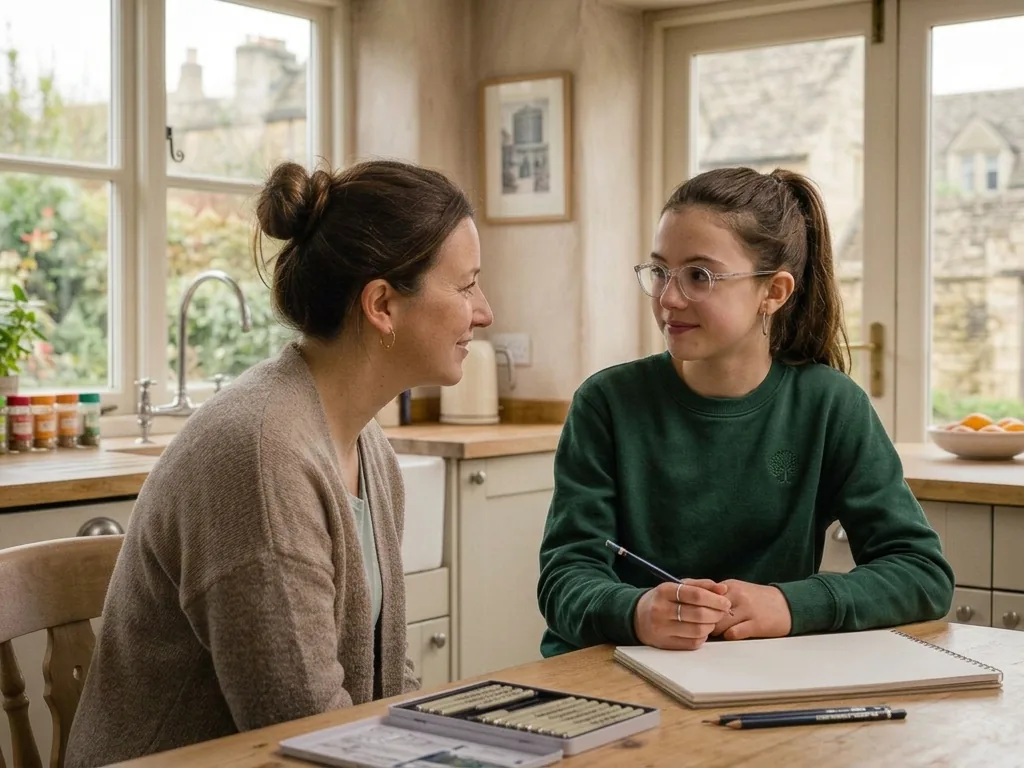
You don’t need a dentist in the family
Most children only ever meet a dentist in the dentist’s chair, and for some that is where the idea starts. If your child has mentioned it, ask what caught their attention there.
Ask them why
A student who can say what draws them to dentistry — beyond “I like science” and “it pays well” — is a student who will interview well and, more importantly, will not spend five years regretting it.
Let them test it early
The pathways are built to be worked through over years, not weeks. Starting in Year 9 is worth more than a rush in Year 12.
Do not do it for them
Dental schools ask candidates to reflect on their own experience. Coaching them into an answer that is not theirs is visible from the other side of an interview table.
Illustration. AI-generated, not real footage.
Safeguarding and privacy
DentiSpark is used by children. We publish a safeguarding policy with a named lead and a route for raising a concern, and any concern raised is acknowledged by the lead within one working day. If something cannot wait, the policy gives 999 and the NSPCC.
Some tools ask for a free account because they save what a student writes. What we collect and why is set out in the privacy policy.